

Technical Resources
IADD's technical resources include specialized documentation, tools, and support services tailored to the unique needs of directional drilling operations. These resources provide detailed guidance on best practices, safety protocols, and innovative techniques to enhance drilling efficiency and accuracy. Additionally, they offer training programs and access to expert advice, ensuring that members stay updated with the latest advancements and industry standards.

INTRODUCTION TO WELLBORE POSITIONING
This comprehensive industry reference e-book has been created by the leading experts in wellbore surveying. Overseen by Professor Angus Jamieson and the University of the Highlands and Islands, this resource is the gold standard of industry knowledge about the art and science of wellbore surveying, surveying technologies, survey accuracy, survey errors, and best practices.
Wellbore Positioning is a thorough technical guide dedicated to the science and engineering of accurately determining the position of wellbores in the subsurface. Designed for professionals in the oil and gas industry, this book explores critical topics including survey measurement techniques, uncertainty modeling, magnetic and gyroscopic tools, and anti-collision strategies. By presenting both the theoretical foundations and practical applications of wellbore surveying, it equips readers with the knowledge needed to improve well placement, optimize drilling efficiency, and ensure safety. This updated edition reflects industry standards and advancements, making it an essential resource for directional drilling engineers, survey specialists, and geoscientists.

INDUSTRY STANDARD 3-D TORTUOSITY INDEX CALCULATION METHOD
Angus Jamieson, on behalf of ISCWSA, performed a thorough analysis of the various methods for calculating tortuosity. His work has resulted in the 3-D Tortuosity method in the attached in this PowerPoint presentation. This method has been used extensively over the last few years by Angus in his work with major oil and gas clients and is currently implemented in the INNOVA software platform.
We invite all companies to add this simple functionality to their software. The text file containing the code is found in this link. The only modification required is for survey frequency less than 90 feet, where a simple correction for course length can be added.
The IADD hereby recommends this as the industry standard for all tortuosity assessments. This is public domain and no rights are reserved.

Positive Displacement Motors: Theory and Applications
Look Inside Positive Displacement Motor: A comprehensive and valuable book written by a team of outstanding experts in this tool and published through SigmaQuadrant publishing. The Positive Displacement Motors covers the full spectrum of topics in terms of analysis and design of the downhole mud motor that serves the workhorse of the downhole drilling system for several decades. This book presents functional, operational and technical aspects of positive displacement motor. It provides a platform ideal to seasoned engineer, experienced researcher and other professionals involved in the drilling operations as it offers real insight into this simple but complex machine. It highlights the background and development of this tool
Provides details of the design
Offers operational guidelines of this tool
Emphasizes technology selection and innovation in the offing
Incorporates practical operating envelop
Mud Motor
Different types of downhole motors are used and common types are:
Percussion Hammers
Positive Displacement Motors (PDM)
Turbines
Electric Downhole Motors (EDM)
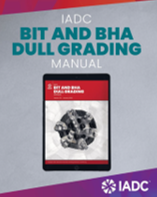
IADC Bit and BHA Dull Grading Manual
The purpose of this resource is to provide recommended practices & an improved framework for bit dull grading. These recommended practices were developed by a joint IADC/SPE subcommittee in an effort to upgrade the IADC dull grading practices, improve operational practice performance, reduce costs & emissions, and provide energy solutions.
The manual covers:
- Drilling Forensics
- Drill Bit Dull Grading
- Bottom Hole Assembly Dull Grading
- Failure Reporting Process
- Data Collection & Visual Information
- Data Management Recommended Practice for Bit, BHA & Operational Data
IADC and IADD Thanks the 160+ volunteer subject matter experts involved in the development of this manual!
We are committed to the continuous update of our technical directional drilling resources to ensure our members have access to the latest industry innovations and best practices.
